Madagascar Visa on Arrival: What You Need to Know
Madagascar offers a visa on arrival (VOA) to citizens of most countries at all major international airports. The process is straightforward but comes with longer wait times compared to the online eVisa. This guide covers eligibility, fees, documents, and how to decide between visa on arrival and the eVisa.
What Is the Madagascar Visa on Arrival?
A visa on arrival is an entry permit you obtain after landing in Madagascar, rather than before your trip. It is stamped directly into your passport at the immigration counter at Ivato International Airport (Antananarivo) and other entry points.
The visa on arrival is available to nationals of most countries worldwide. There is no need to visit an embassy or consulate in advance – you complete all paperwork and payment at the airport upon arrival.
Who Is Eligible for Visa on Arrival?
Citizens of nearly all countries can obtain a visa on arrival in Madagascar. There are no nationality restrictions beyond a handful of countries that require a pre-arranged visa through a Malagasy embassy.
| Eligible | Not Eligible for VOA |
|---|---|
| All EU/EEA countries | A few restricted nationalities |
| United States, Canada, Australia | Diplomatic passport holders from certain states |
| United Kingdom, Switzerland | Travelers without valid passport |
| India, China, Japan, South Korea | – |
| Brazil, Argentina, Mexico | – |
| South Africa, Nigeria, Kenya | – |
If you hold a passport from a restricted country, you must apply through a Malagasy embassy or consulate before traveling. The vast majority of travelers qualify for visa on arrival.
Madagascar Visa on Arrival Fees
The visa on arrival fee is paid in cash (EUR or USD) at the immigration counter. Fees are the same regardless of nationality and match the eVisa fees exactly.
| Duration | Fee (EUR) | Fee (approx. USD) |
|---|---|---|
| Up to 15 days | €30 | ~$33 USD |
| 16 to 30 days | €35 | ~$38 USD |
| 31 to 60 days | €40 | ~$44 USD |
| 61 to 90 days | €50 | ~$55 USD |
Children and infants pay the same fee as adults – there is no reduced rate for minors.
The fee is non-refundable. If your application is denied at the border, you will not receive a refund.
Required Documents for Visa on Arrival
Prepare these documents before your flight:
- Valid passport – at least 6 months remaining validity from your date of arrival, with at least 2 blank pages
- Return or onward flight ticket – proof that you intend to leave Madagascar within your visa duration
- Accommodation details – hotel booking confirmation or host’s address in Madagascar
- Completed arrival form – provided on the plane or at the immigration counter
- Yellow fever vaccination certificate – required if you are transiting through or arriving from a country with yellow fever risk
The yellow fever certificate is often checked at immigration even if your home country is not a yellow fever zone. If you transited through Nairobi, Addis Ababa, or another hub in sub-Saharan Africa, bring your certificate.
How to Get a Visa on Arrival: Step by Step
Step 1: Arrive at Immigration
After landing, proceed to the immigration hall. You will see separate queues for different visa types. Follow signs for visa on arrival.
Step 2: Complete the Arrival Form
Fill in the arrival/disembarkation card with your personal details, flight number, accommodation, and length of stay.
Step 3: Pay the Fee
Pay the visa fee in EUR or USD cash at the designated counter. Credit cards are not accepted for visa on arrival. Bring exact change if possible.
Step 4: Receive Your Visa Stamp
The immigration officer will stamp your passport with the visa and write the authorized duration of stay. Double-check the dates before leaving the counter.
Step 5: Proceed to Customs
After clearing immigration, collect your luggage and pass through customs. Your visa on arrival process is complete.
The entire visa on arrival process typically takes 30 to 60 minutes, but can exceed 90 minutes during peak arrival times when multiple flights land simultaneously.
Visa on Arrival vs eVisa: Which Should You Choose?
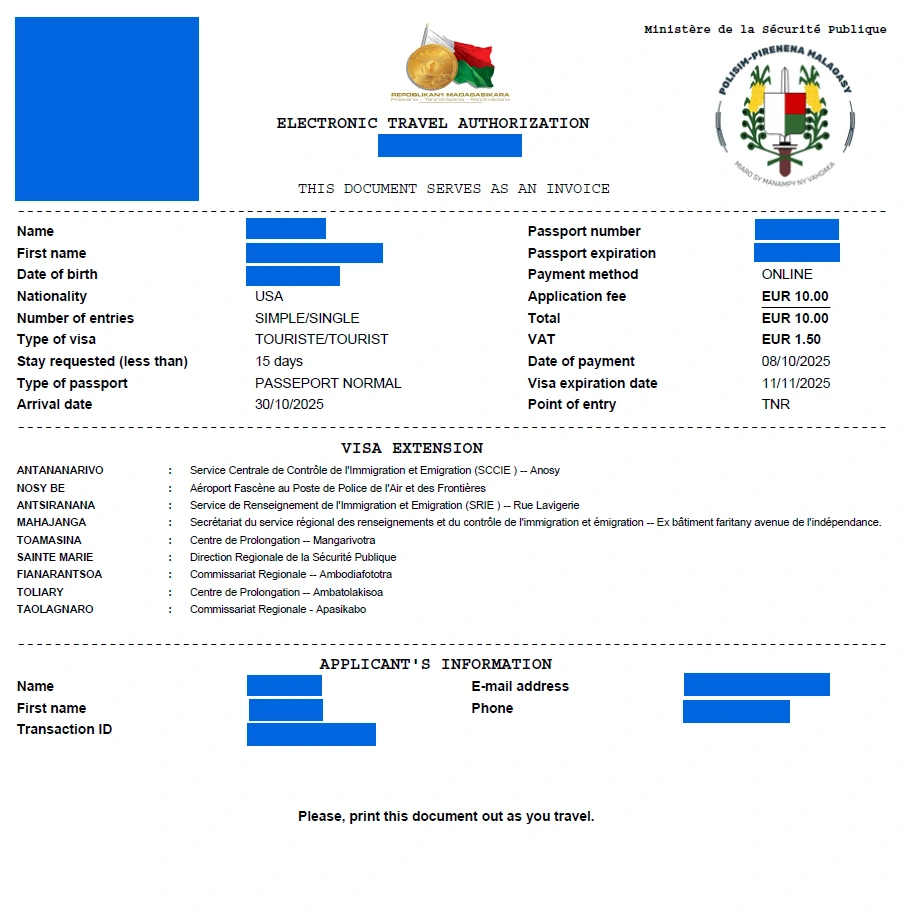
The eVisa system lets you apply online before your trip. Here is how the two options compare.
| Feature | Visa on Arrival | eVisa |
|---|---|---|
| Application | At the airport | Online before travel |
| Processing time | 30-90 minutes at airport | 48-72 hours online |
| Cost | €30-€50 (same fees) | €30-€50 (same fees) |
| Payment method | Cash (EUR/USD) | Credit/debit card |
| Advance approval | No guarantee before travel | Confirmed before departure |
| Queue | Longer during peak hours | Faster immigration clearance |
| Document check | At the border | During online application |
The eVisa is recommended for most travelers because it provides confirmed approval before you fly, eliminates cash handling at the airport, and speeds up your immigration process. Read more about the Madagascar eVisa fee structure.
Can You Extend a Visa on Arrival?
Yes. If you need more time in Madagascar, you can extend your visa at the PAF (Police de l’Air et des Frontières) office in Antananarivo.
| Extension | Approximate Fee |
|---|---|
| 30-day extension | €25-€35 |
| Additional 30 days | €25-€35 |
Extensions must be applied for before your current visa expires. Overstaying without an extension incurs a fine of €30 or more per day of overstay, and you may face difficulties with future entry.
Common Mistakes to Avoid
- Not bringing enough EUR/USD cash – There are no ATMs in the immigration hall. Bring the exact fee in cash.
- Forgetting yellow fever certificate – If you transited through a yellow fever country, you will be asked for it.
- Insufficient passport validity – Your passport must have at least 6 months remaining. Airlines may deny boarding if your passport is close to expiry.
- Relying on credit cards – Visa on arrival fees are cash-only. Card payments are not accepted at immigration.
- Choosing the wrong duration – The visa duration is fixed at the border. If you initially requested 15 days but need 30, you must request an extension later and pay again.
Tips for a Smooth Arrival
- Carry the fee in small EUR or USD bills. Large notes ($100/€100) may not be accepted or may receive poor exchange rates.
- Print your return flight ticket and hotel confirmation. Digital copies on your phone work but paper is safer.
- Arrive with your arrival form already filled in to save time in the queue.
- If you are visiting multiple destinations in Madagascar, consider a 60 or 90-day visa to avoid extension fees.
Frequently Asked Questions
How much does a Madagascar visa on arrival cost?
The visa on arrival costs €30 for up to 15 days, €35 for 16-30 days, €40 for 31-60 days, and €50 for 61-90 days. Payment is accepted in EUR or USD cash only.
Can I pay for the visa on arrival with a credit card?
No. Visa on arrival fees must be paid in cash – either EUR or USD. Credit cards and debit cards are not accepted at the immigration counter.
Do children need to pay for a visa on arrival?
Yes. Children and infants pay the same visa fee as adults. There is no reduced rate for minors.
Is the visa on arrival the same as the eVisa?
The visa on arrival and eVisa grant the same type of entry permit with identical fees and durations. The difference is the application method: VOA is obtained at the airport, while the eVisa is approved online before travel.
What currency should I bring for the visa on arrival?
Bring EUR (euros) or USD (US dollars) in cash. Euros are preferred as the fee is officially set in EUR. Small bills are recommended.
How long does the visa on arrival process take?
The process typically takes 30 to 60 minutes. During peak arrival times when multiple flights land together, it can take up to 90 minutes or more.
Can I extend my visa on arrival in Madagascar?
Yes. You can extend your visa at the PAF office in Antananarivo for approximately €25-€35 per additional 30 days. Apply before your current visa expires to avoid overstay fines.
Do I need a yellow fever certificate for Madagascar?
A yellow fever vaccination certificate is required if you are arriving from or transiting through a country with yellow fever risk. This includes many countries in sub-Saharan Africa and South America.